
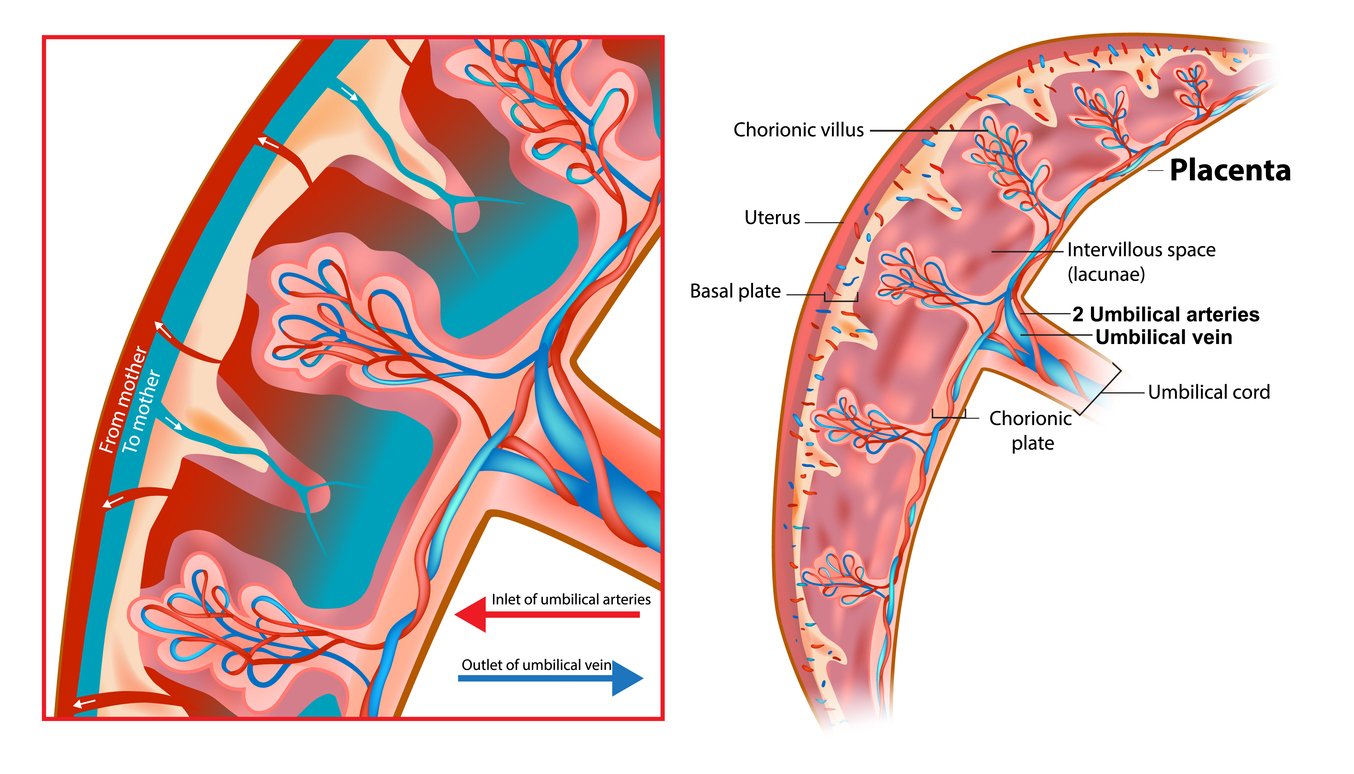
Non-animal methods for studying human pregnancy offer more accurate and ethical alternatives to cruel and inapplicable animal experiments that harm mother and baby animals. These innovations focus on creating in vitro models that mimic placental tissue and using advanced imaging techniques for detailed, non-invasive physical assessment.
In Vitro Models and Organoids
Several cutting-edge models have been developed to study the complex functions of the placenta outside of a living organism:
- Mini Placentas and Organoids: Scientists are creating trophoblast organoids (or "mini-placentas") derived from human stem cells. These structures accurately mimic the human placenta, allowing for a deeper understanding of human development and the potential treatment of related disorders [1]. Similarly, 3D-Printed Mini Placentas are created using 3D bioprinting, combining placental cells with a synthetic gel that is free from animal products [2]. This method produces placental organoids that closely mimic human placental tissue during early pregnancy.

- Three-Organ-Chip System: To better predict how drugs cross the blood-placental barrier, biotech companies have engineered a three-organ-chip system [3]. This microphysiological platform integrates chips representing the liver, intestine, and placenta, connected by an integrated pump system that circulates cell medium. By testing familiar drugs like prednisone and combining the data with mathematical models, a "digital twin" can be created to predict drug distribution and metabolism in a pregnant individual [3].
Advanced Placental and Prenatal Imaging
Non-invasive imaging technologies are being enhanced to allow accurate clinical detection of fetal growth and placental function:
- Advanced Placental MRI: 3D MRI is used to analyze various placental features—including shape, volume, thickness, elongation, and texture—to provide early detection of placental dysfunction and potentially improve outcomes [4]. A specific technique, pCASL (pseudocontinuous Arterial Spin Labeling) MRI, is a non-invasive method for quantifying placental blood flow [5]. It uses magnetic pulses to monitor blood flow without needing contrast agents, facilitating the identification of decreased perfusion that may indicate complications like ischemic placental disease (IPD) or fetal growth restriction in early pregnancy [5].
- Advanced Ultrasound: Ultrasound techniques are continuously being refined for better visualization and assessment. Superb microvascular imaging (SMI) enhances the visualization of small vessels, such as the micro-vessels in the placenta, by suppressing motion artifacts while preserving low-flow components [6]. 3D ultrasound incorporating Power Doppler ultrasound (PD-US) is an ideal, safe, and cost-effective modality to assess tissue perfusion without requiring ionizing radiation [7].

These non-animal methods provide powerful, high-fidelity tools for both basic research and clinical applications, paving the way for improved understanding and management of human pregnancy complications.
References
- Li, Q et al. Human uterine natural killer cells regulate differentiation of extravillous trophoblast early in pregnancy. Cell Stem Cell; 17 Jan 2024; DOI: doi.org/10.1016/j.stem.2023.12.013
- Richards, C., Chen, H., O’Rourke, M. et al. Matrix directs trophoblast differentiation in a bioprinted organoid model of early placental development. Nat Commun 16, 8267 (2025). https://doi.org/10.1038/s41467-025-62996-0.
- Graf, K., et al. (2025). Digital twin-enhanced three-organ microphysiological system for studying drug pharmacokinetics in pregnant women. Frontiers in Pharmacology. doi.org/10.3389/fphar.2025.1528748
- Dahdouh, S., et al. In vivo placental MRI shape and textural features predict fetal growth restriction and postnatal outcome. Journal of Magnetic Resonance Imaging, 2017; DOI: 10.1002/jmri.2580
- Herrera CL, et al. Longitudinal assessment of placental perfusion in normal and hypertensive pregnancies using pseudo-continuous arterial spin-labeled MRI: preliminary experience. Eur Radiol. 2023 Dec;33(12):9223-9232. doi: 10.1007/s00330-023-09945-x
- Odibo AO, et al. Longitudinal assessment of spiral artery and intravillous arteriole blood flow and adverse pregnancy outcome. Ultrasound Obstet Gynecol. 2022 Mar;59(3):350-357. doi: 10.1002/uog.23760
- Yin Y, Clark AR, Collins SL. 3D Single Vessel Fractional Moving Blood Volume (3D-svFMBV): Fully Automated Tissue Perfusion Estimation Using Ultrasound. IEEE Trans Med Imaging. 2024 Jul;43(7):2707-2717. doi: 10.1109/TMI.2024.3376668.
Showing 1 reaction